Best Age to Start Preschool: A Practical Guide
Parenting, Preschool, Early Childhood Education
What Is the Best Age to Start Preschool? A Calm, Practical Guide for Parents
If you’re wondering when your child should start preschool, you’re not alone. For many parents in Fort Lauderdale, Plantation, Davie, Dania Beach and nearby Broward County communities, this decision feels big, especially if your child is sensitive, neurodiverse, or easily overwhelmed by noise and crowds. Let’s walk through what really matters when deciding the best age to start preschool, and how a calm Montessori environment like Ambassador Kids Montessori can support your child’s unique journey.
Is There Really a “Perfect” Age to Start Preschool?
You’ll often hear that children should start preschool at age three. Others say four. Some families begin earlier, especially if both parents work full-time. The truth is, there is no one-size-fits-all “perfect” age. Every child’s development, personality, and family situation is different and that’s okay.
Instead of searching for a magic number, it’s more helpful to ask: “Is my child ready for a small, loving community where they can explore, learn, and grow?” At Ambassador Kids Montessori, we welcome children ages 3 to 6 and focus on readiness, not pressure. We look at the whole child, socially, emotionally, physically, and spiritually, before recommending a start age and schedule that feels right for your family.
Typical Preschool Ages: 3 to 4 Years Old
Most children begin preschool sometime between their third and fourth birthdays. Around this stage, many children are:
Curious and eager to imitate adults and older children
Ready for simple routines and consistent expectations
Interested in playing near or with other children, not just alongside them
Beginning to use words to express needs, feelings, and choices
In a Montessori preschool, these developmental changes are welcomed and gently guided. Children are introduced to Practical Life activities like pouring, spooning, and caring for plants; Sensorial materials that refine their senses; and early Language and Math experiences that build strong foundations for kindergarten, without rushing or overwhelming them.
💡 Gentle Reminder: Age is just one piece of the puzzle. Readiness, temperament, and the type of preschool environment matter just as much, if not more.
Signs Your Child May Be Ready for Preschool
Whether your child is 3, 4, or somewhere in between, look for these gentle indicators of preschool readiness. Your child does not need to meet every single one perfectly; these are simply helpful guideposts:
Separation tolerance: Your child can handle short separations from you with support, or is beginning to show they can calm with a trusted adult nearby.
Curiosity about other children: They watch, imitate, or want to join in with peers, even if they still prefer parallel play at times.
Emerging independence: They like to do things “by myself” such as washing hands, putting toys away, or helping with simple home tasks.
Ability to follow simple directions: They can follow one- or two-step instructions with gentle reminders and visual cues.
Growing communication: They can express basic needs with words, signs, or gestures, even if speech is still developing.
For children with unique abilities or sensory differences, these signs may appear on a different timeline. At Ambassador Kids Montessori, we partner with families including those using Step Up’s Unique Abilities scholarship to understand what readiness looks like for their child, not just for a textbook child.
The Role of Environment: Why “Where” Matters as Much as “When”
Many parents worry that their child will be overlooked, overwhelmed, or overstimulated in a large, noisy classroom. This concern is especially real for neurodiverse children or those who are shy, sensitive, or still building emotional regulation skills. In these cases, the best age to start preschool is often the age at which you can place them in the right kind of environment.
At Ambassador Kids Montessori, we intentionally keep our group very small no more than five children. This allows us to:
Notice each child’s cues and sensory needs quickly
Offer individualized, hands-on lessons at the right pace
Maintain a calm, home-like atmosphere rather than a chaotic one
Build genuine relationships with each child and family
In a peaceful, well-prepared Montessori classroom, younger three-year-olds and older five-year-olds can thrive side by side. Younger children watch and learn from older peers, while older children grow in leadership, kindness, and confidence. This mixed-age community is one reason many families choose to start earlier and stay through the kindergarten year.
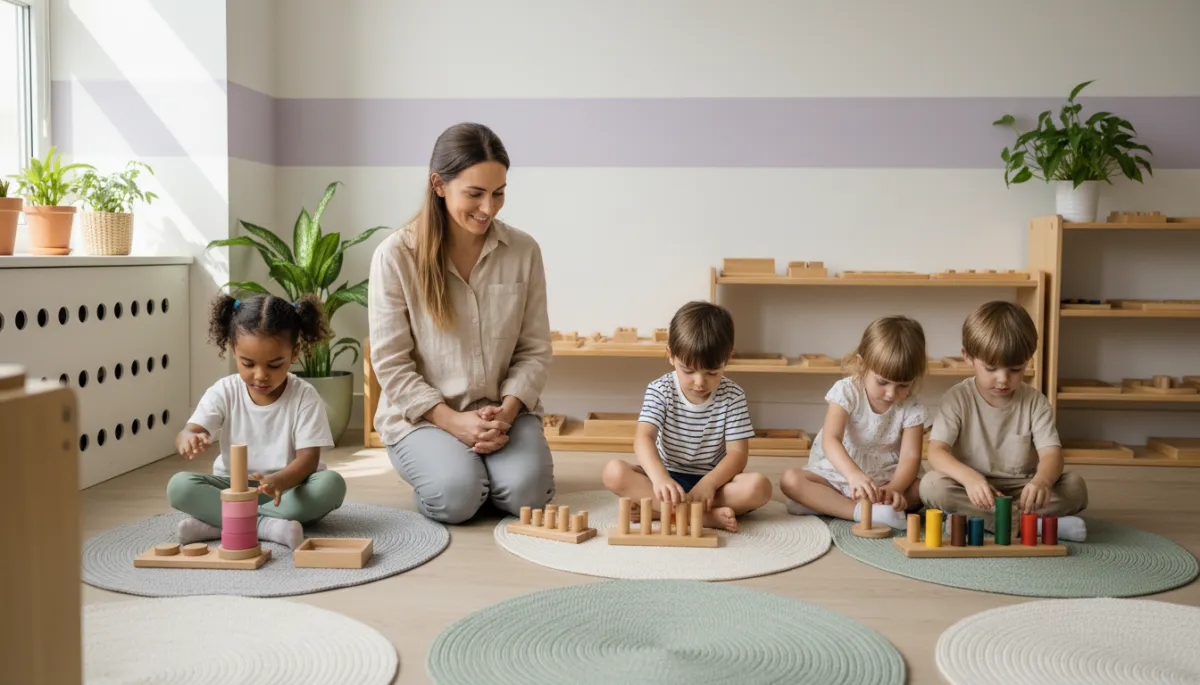
Mixed-age Montessori groups let younger children learn from older role models naturally.
Benefits of Starting Preschool Around Age 3
For many families, age 3 is a beautiful time to begin preschool, especially in a calm, nurturing setting. Some of the key benefits include:
Gentle socialization: Children practice sharing space, taking turns, and using kind words in a guided, respectful way rather than through trial and error in a crowded room.
Early independence: Simple routine, hanging a backpack, choosing work, cleaning up, build confidence and self-respect day by day.
Hands-on learning: Montessori materials make abstract ideas, like counting or letter sounds, concrete and enjoyable rather than stressful “school work.”
Emotional support: In a small Christian preschool, children are guided with grace, courtesy, and faith-based values that nurture their hearts as well as their minds.
Starting at three also gives children more time to grow into leadership roles as they approach kindergarten age. By five or six, they are often the ones showing younger friends how to roll a mat, carry a tray, or speak gently, skills that carry into elementary school and beyond.
What If My Child Is Closer to 4 or 5 Before Starting?
Some children begin preschool closer to age four or even five. This may be due to family schedules, health needs, or simply waiting until your child seems more ready. Starting later is not “too late.” In fact, many four-year-olds step into a Montessori environment and quickly flourish because they are developmentally ready to focus, follow routines, and engage deeply with materials.
At Ambassador Kids Montessori, older preschoolers benefit from:
More advanced Language and Math materials that prepare them for reading, writing, and number sense in kindergarten
Rich Science and Culture experiences that feed their curiosity about God’s world
Opportunities to practice leadership, empathy, and problem-solving with younger classmates
Whether your child starts at three, four, or five, what matters most is that they enter a setting where they are seen, known, and guided as an individual, not rushed to “catch up” or left to struggle alone.
Considering Neurodiverse Children and Unique Abilities
If your child has a diagnosis, receives therapies, or you simply suspect they process the world differently, you might feel extra pressure to “get the timing right.” Please know: you are not behind, and you do not have to figure this out alone.
In our small Christian Montessori preschool, we work closely with families, including those using Step Up’s Unique Abilities scholarship to understand:
Your child’s sensory profile and what helps them feel safe and calm
How they communicate best—through words, pictures, routines, or movement
How to gradually introduce them to the classroom at a pace that respects their nervous system
For some neurodiverse children, starting preschool a bit earlier in a very small, predictable setting can actually reduce anxiety and build resilience over time. For others, waiting until closer to four is more appropriate. The “best age” is the one that honors your child’s dignity, protects their peace, and supports their growth step by step.
So…What Is the Best Age to Start Preschool?
When we put all of this together, a clear picture emerges. For many children, the ideal window to start preschool is between ages 3 and 4, in a calm, well-structured environment that offers:
Small groups and individualized attention
Hands-on, purposeful learning rather than worksheets and pressure
Consistent routines that help children feel safe and confident
Christian values of kindness, respect, and grace woven into daily life
But the best age for your child also depends on their temperament, your family’s needs, and the specific preschool you choose. A gentle, home-like Montessori program with no more than five children will feel very different from a large, busy center, even if the children are the same age in both settings.
How Ambassador Kids Montessori Can Help You Decide
You do not have to make this decision in isolation. At Ambassador Kids Montessori in Fort Lauderdale, our role is to listen, guide, and partner with you. During a conversation, we talk about:
Your child’s personality, strengths, and sensitivities
Any therapies, supports, or scholarships (including Step Up’s Unique Abilities) your family uses
Your hopes for your child’s confidence, independence, friendships, and kindergarten readiness
Together, we consider whether starting now or waiting a bit longer, will serve your child best. Because we keep our program intentionally small, we never want to rush a family or place a child in an environment that isn’t the right fit. Our promise is simple: every child is seen, known, and guided as an individual.
📌 Key Takeaway: The best age to start preschool is when your child can enter a calm, loving environment that respects their pace and supports their growth, not just when they reach a certain birthday.
Ready to Talk About Your Child’s Next Step?
If you’re in Fort Lauderdale, Plantation, Davie, Dania Beach or nearby Broward County communities and you’re wondering whether now is the right time for preschool, we would be honored to talk with you. Ambassador Kids Montessori offers a Monday through Thursday program with real Montessori materials, consistent routines, and Christian values in a quiet, home-like setting.
Call or text 954-994-1189 to ask about current availability and schedule a Zoom Introduction. During our conversation, you’ll have space to share your child’s needs and your desires for their early years. We’ll explain how our small Christian Montessori preschool works and, together, decide whether Ambassador Kids Montessori may be the right place and the right time for your child to begin their preschool journey.
© Ambassador Kids Montessori
Contact Us: